
Most of us notice the closet first when we run out of storage. When the hanging rod starts bowing and the dresser drawers refuse to close, panic sets in. We look everywhere for a spot to shove our extra sweaters or holiday decorations. The funny thing is, we often forget the few feet of hidden space sitting right underneath where we sleep.
Proper under-bed storage is one of the smartest ways to clear the visual clutter in your room. It is completely out of sight, utilizes space that is otherwise just catching dust bunnies, and costs a fraction of buying a new dresser.
If your room feels cramped and chaotic, you might be sitting on (or rather, sleeping over) the perfect solution. Let’s look at how to maximize that empty space without turning it into a black hole for lost socks and junk.
Table of Contents
Why 7Under-Bed Storage Is So Valuable
Take a moment to look at the footprint of your bed. A standard queen-size bed takes up roughly 33 square feet of floor space. In an apartment, dorm room, or a smaller house, that is a massive amount of real estate dedicated to a single piece of furniture.
By ignoring the gap between the mattress and the floor, you are essentially wasting unused square footage. Utilizing this area transforms a single-purpose piece of furniture into a heavy-duty storage solution.
This hidden storage is especially helpful for people trying to maximize bedroom space. Instead of buying bulky armoires or bringing in extra shelving units that make the room feel cramped, you can keep clutter completely out of sight.
When you use the space under your bed correctly, your room immediately looks larger and more relaxed. Your closet gets room to breathe, your nightstands stay clear of random junk, and you get peace of mind knowing exactly where your off-season gear is hiding.
[Internal Link Suggestion: Small Bedroom Organization Guide]
What You Can Actually Store Under Your Bed
Not everything belongs under your bed. Because this area is low to the ground and slightly harder to access than a traditional drawer, it is best suited for items you do not need every single day.
Here are some of the most practical things to slide under your frame:
- Seasonal clothing: Thick winter coats, bulky sweaters, or summer swimsuits that only see daylight a few months a year.
- Shoes: Especially off-season footwear like snow boots or specialty shoes you only wear to weddings.
- Blankets and extra bedding: Guest sheets, heavy winter duvets, and spare pillows.
- Luggage: You can even store smaller items inside empty suitcases before sliding them under the bed.
- Holiday decorations: Wrapping paper rolls and soft decor items are perfect for this flat space.
- Books and files: Archived paperwork or books you’ve read but want to keep.
- Children’s toys: Track systems, board games, or big boxes of building blocks.
- Rarely used accessories: Handbags, travel backpacks, or hobby gear.
What to Keep Out
Avoid storing anything highly vulnerable to extreme temperature shifts, moisture, or pests. Unprotected historical family photos, sensitive electronics, and food items should stay far away from the floor. You also want to avoid tossing loose, uncontained items under there, as they will quickly gather dust and become impossible to retrieve.
Best 7Under-Bed Storage Ideas
When it comes to bedroom organization, there is no one-size-fits-all solution. The best under-bed storage ideas depend on your flooring, the height of your bed frame, and what you need to store.
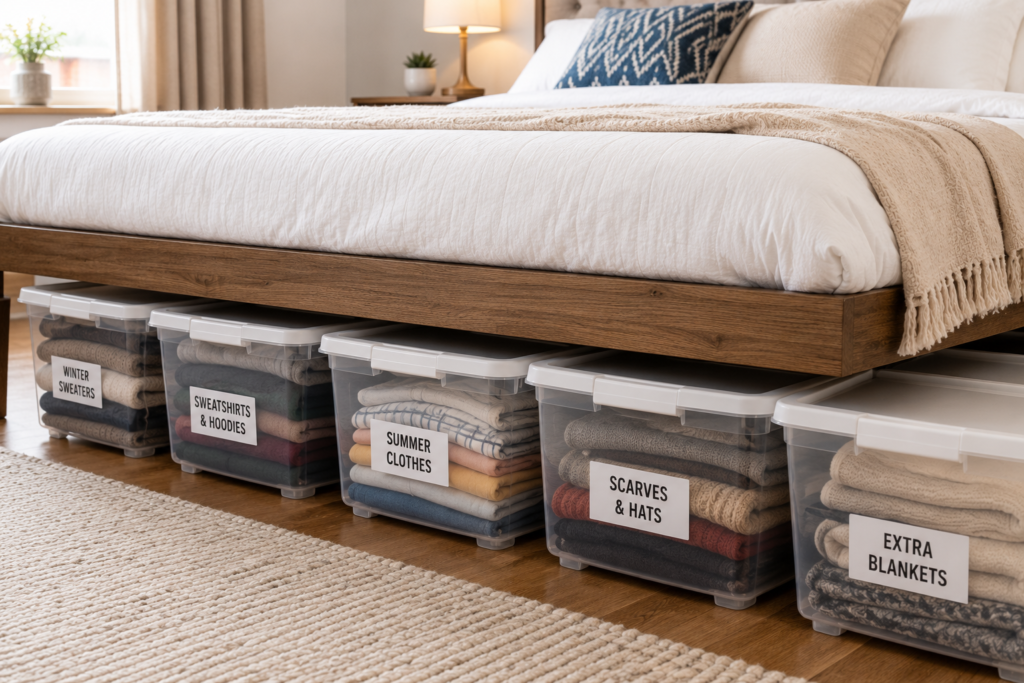
Here are the most popular bed storage solutions:
Rolling Containers If you have hard floors, rolling under bed storage is fantastic. These wood or plastic bins have small caster wheels, making it incredibly easy to pull them out when you need something.
- Advantage: Easy on the back; great for heavier items like books or shoes.
- Disadvantage: The wheels take up vertical space, so you need a taller bed frame.
Plastic Storage Bins Long, flat plastic bins with latching lids are the classic choice. They usually slide fairly well on carpet.
- Advantage: Excellent protection against dust, moisture, and pests.
- Disadvantage: Can look a bit clinical if your bed doesn’t have a bedskirt to hide them.
Fabric Storage Bags Soft-sided, zippered fabric bags are flexible and lightweight. They often feature clear plastic tops so you can see what is inside.
- Advantage: Squishable. If your bed frame is a bit low, you can often gently squeeze these bags to make them fit.
- Disadvantage: They offer zero protection against heavy weight and can be tough to slide on thick carpet.
Vacuum Storage Bags If you have massive, fluffy winter comforters taking up your entire closet, vacuum bags are the answer.
- Advantage: Compresses bulky linens down to a fraction of their size.
- Disadvantage: Items can come out wrinkled, and the plastic bags themselves can tear if snagged on a sharp bed frame.
Drawer-Style Organizers These are structured units that sit on the floor but function like dresser drawers. You just pull the drawer out while the frame stays in place.
- Advantage: Very clean, built-in look.
- Disadvantage: Usually more expensive and harder to assemble.
Repurposed Boxes and DIY Solutions You don’t always have to spend a fortune. Old dresser drawers with casters screwed onto the bottom make beautiful, rustic DIY storage. Sturdy cardboard boxes work too, though they won’t last forever.
“How to Build Under-Bed Storage Drawers”
Choosing the Right Storage Containers
Before you rush out to buy storage bins under bed dimensions, you have to do a little prep work. Buying the wrong containers is a fast way to get frustrated.
First, grab a tape measure. You need to know the exact clearance between the floor and the lowest part of your bed frame (which is often the side rail, not the mattress support). Also, measure the width between the legs of the bed. A giant bin is useless if it cannot fit between the center support posts.
Consider the following features when shopping:
- Lids: Always choose containers with tight-fitting lids or zippers. The area under a bed is a magnet for dust.
- Accessibility: Do you need handles? If the bin is going in deep, a sturdy handle on the front is a lifesaver.
- Ventilation: If you are storing natural fibers like wool, leather, or silk, they need to breathe. Fabric bins are better for these than airtight plastic.
- Transparency: Clear bins let you see what you own without opening them. If you prefer opaque bins to hide visual clutter, make sure to use large, clear labels.
[Internal Link Suggestion: Best Space-Saving Home Products]
Common Under-Bed Storage Mistakes
Even the best-laid organizational plans can go wrong. When decluttering bedroom spaces, try to avoid these common pitfalls:
1. Buying Containers That Are Too Tall There is nothing worse than bringing home a stack of fresh bins only to realize they are half an inch too tall to slide under the rail. Always measure twice.
2. Storing Everyday Items Getting down on your hands and knees every morning to grab your daily work shoes will get old fast. Reserve this space for things you need weekly, monthly, or seasonally.
3. Ignoring the Dust Out of sight usually means out of mind for the vacuum cleaner. If you don’t use lidded containers, whatever you put under there will eventually be covered in a layer of grime.
4. Creating Clutter Instead of Organization Shoving loose shoes, random shopping bags, and crumpled papers under the bed isn’t organizing—it’s just hiding the mess. If it isn’t in a contained bin or bag, it shouldn’t be under there.
5. Storing Heavy Items in Flimsy Bags Putting thirty hardcover books into a soft fabric bag will end in a ripped zipper and a frustrated owner. Match the durability of the container to the weight of the items.
How to Organize Under Your Bed
Ready to tackle the mess? Follow this simple step-by-step system to get your space-saving storage dialed in.
- Take everything out. Yes, everything. Pull out the dust bunnies, the lost socks, and the old shoeboxes.
- Declutter. Don’t organize garbage. If you pulled out items you haven’t used in two years, donate or throw them away.
- Group similar items. Put all the off-season clothes in one pile, spare linens in another, and shoes in a third.
- Measure the space. Note the height, width, and depth of your available under-bed area.
- Choose the right containers. Based on your measurements and categories, grab the appropriate bins or bags.
- Create zones. Treat the space under your bed like a map. Put items you might need sooner (like spare guest sheets) near the edges. Push strictly seasonal items (like Christmas ornaments) into the hard-to-reach center or back corners.
- Label everything. Even if you use clear bins, slap a label on the side that faces outward. It saves you from dragging out three heavy boxes just to find your winter scarves.
Under-Bed Storage for Small Bedrooms
If you live in a studio apartment, a dorm room, or a tiny shared house, your under-bed storage isn’t just a bonus—it’s your main closet.
For really tight spaces, consider investing in bed risers. These are sturdy plastic or wood blocks that sit under the legs of your bed frame, safely lifting the entire bed a few inches higher. Going from six inches of clearance to ten inches completely changes what you can store. Suddenly, standard-sized storage boxes fit perfectly.
In small homes, you might also want to look into beds with built-in storage. Platform beds with integrated wooden drawers look incredibly sleek and completely eliminate the need to buy separate bins. They hide everything beautifully, ensuring your small bedroom storage looks intentional rather than cluttered.
[Internal Link Suggestion: Home Storage Ideas]
Frequently Asked Questions
Is it a good idea to store things under the bed? Yes, it is a highly effective way to maximize bedroom space, provided you do it correctly. As long as items are kept in clean, closed containers to protect them from dust, it is an excellent use of wasted space.
What should I not store under my bed? Avoid storing unsealed food, important unprotected documents, delicate photos that could curl from floor-level humidity, or anything that you need to access multiple times a day.
How do I keep under-bed storage dust-free? The best defense is a good offense. Always use bins with tight-latching lids or zippered fabric bags. Never store loose items directly on the floor.
Are plastic bins better than fabric bags? It depends on what you are storing. Plastic bins offer superior protection against pests and moisture and are great for hard items or garage-type storage. Fabric bags are breathable, making them slightly better for natural fiber clothing and bulky linens, plus they can squeeze into tighter spaces.
How do I organize a small space under my bed? Use modular, rectangular containers that fit together tightly so no space is wasted. Place the items you use least often in the back or center, and keep things you occasionally need right at the edge.
Is under-bed storage good for clothes? Yes, it is perfect for off-season clothing. Just make sure the clothes are washed and completely dry before storing them, and use breathable fabric bags or add cedar blocks to plastic bins to keep everything fresh.
How often should I clean under my bed? Aim to pull out your storage containers and vacuum the floor underneath at least once every three to four months. It is easiest to do this when you are swapping out seasonal clothing.
Final Thoughts
You don’t need a massive walk-in closet to have an organized, peaceful bedroom. You just need to look at your existing furniture a little differently.
By treating the space beneath your mattress as an extension of your closet, you can clear your floor, empty your crowded dressers, and breathe a little easier. Grab a tape measure, figure out your clearance, and start reclaiming your room. Your future, clutter-free self will thank you for it!